

☕ May 23, 1995 – Java Is Announced: Write Once, Run Anywhere, Change Everything
Sun Microsystems launched a programming language at a California tech conference — and gave the internet its commercial backbone.

The announcement that Sun Microsystems made at the SunWorld conference in San Francisco on May 23, 1995, was framed as a technology demonstration but landed as a paradigm shift. James Gosling and his team had been building Java since 1991 under the internal code name “Oak,” originally designed for interactive cable television boxes. When that market failed to materialize, the team redirected toward the web — then a rapidly expanding environment with one fundamental problem: software written for one computer system could not run on another without modification. Java’s promise, embodied in the phrase “write once, run anywhere,” was to solve this problem by running on a virtual machine that could be installed on any platform.
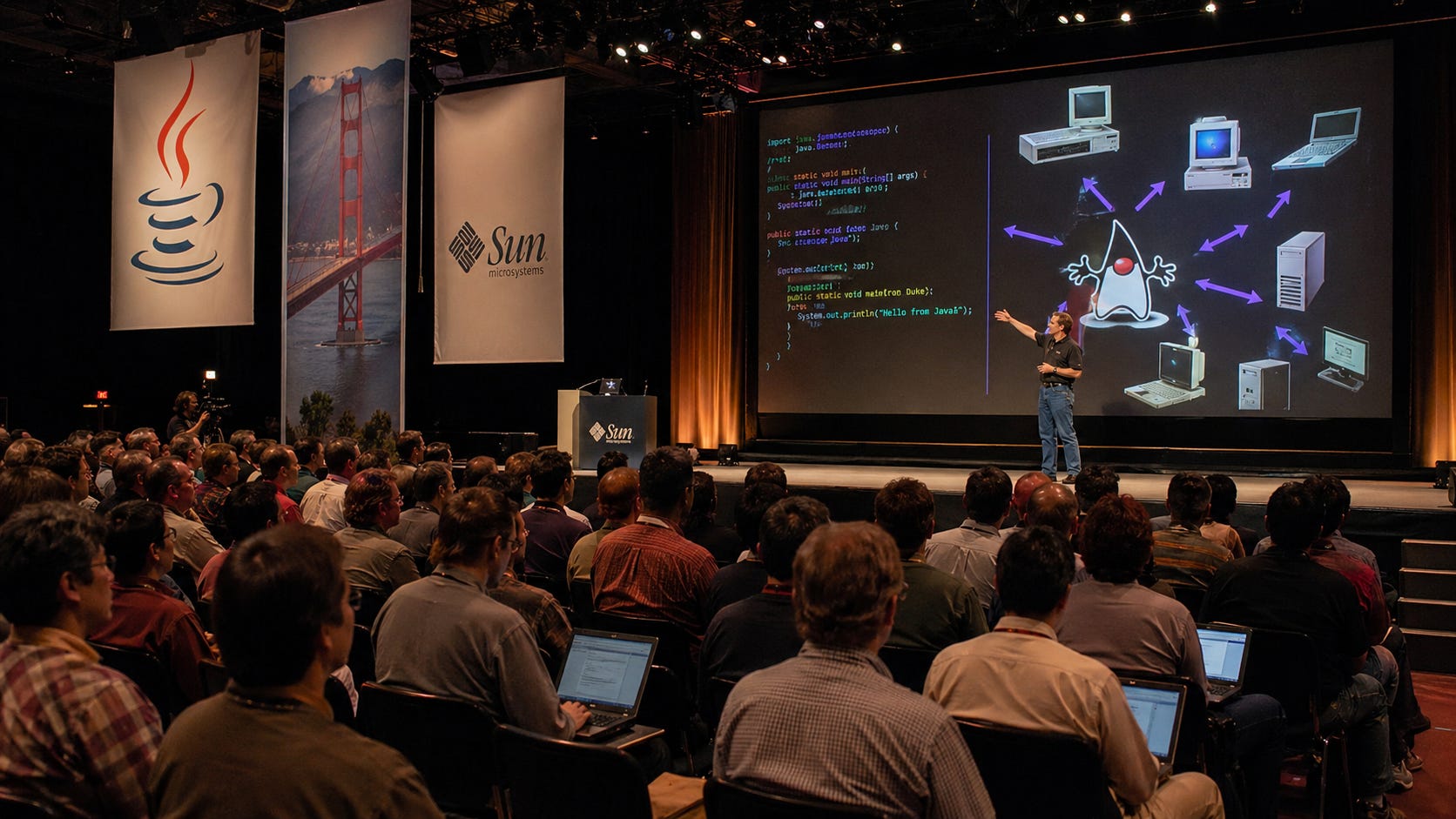
The Partnership That Mattered. On the same stage, Marc Andreessen of Netscape announced that Netscape Navigator would embed Java technology, giving the language immediate access to the web’s fastest-growing user base. The combination of Java’s platform-independence and Netscape’s distribution meant that Java applets — small programs embedded in web pages — could run in any browser on any operating system without requiring users to install anything. For the first time, the web was not just a display medium for documents. It was a platform for applications.
What It Changed. Java’s “write once, run anywhere” model became the foundation of enterprise software development for the next two decades. The language powered the back-end systems of banks, insurers, retailers, and logistics companies — anywhere large institutions needed software that could run across heterogeneous hardware environments. By the late 1990s, Java was the most widely taught programming language in university computer science programs. Android, launched by Google in 2008, used a Java-based language for its application development environment, making Java the most widely used programming language on mobile devices for more than a decade. The commercial applications written in Java process tens of trillions of dollars in financial transactions annually.
Connection to Today. Java remains among the top three programming languages globally by usage. Oracle acquired Sun Microsystems in 2010 and with it full ownership of Java, leading to the landmark Oracle v. Google lawsuit over Android’s use of Java APIs — a case that reached the Supreme Court and was decided in Google’s favor in 2021. The language announced at SunWorld in 1995 is now at the center of the most consequential intellectual property dispute in technology history.
Did You Know? Java was almost named “Silk.” The team considered dozens of names before landing on Java — a reference to coffee, reflecting the amount consumed during the language’s development. “Oak” had been the original code name, but the team discovered that Oak Technologies had already trademarked the name. Other candidates included “DNA,” “Lyric,” and “Neon.” The winning name came from a brainstorming session and was chosen partly because the team liked the way it sounded. The most widely deployed enterprise programming language in history was named after what was in the cup on the developer’s desk.