


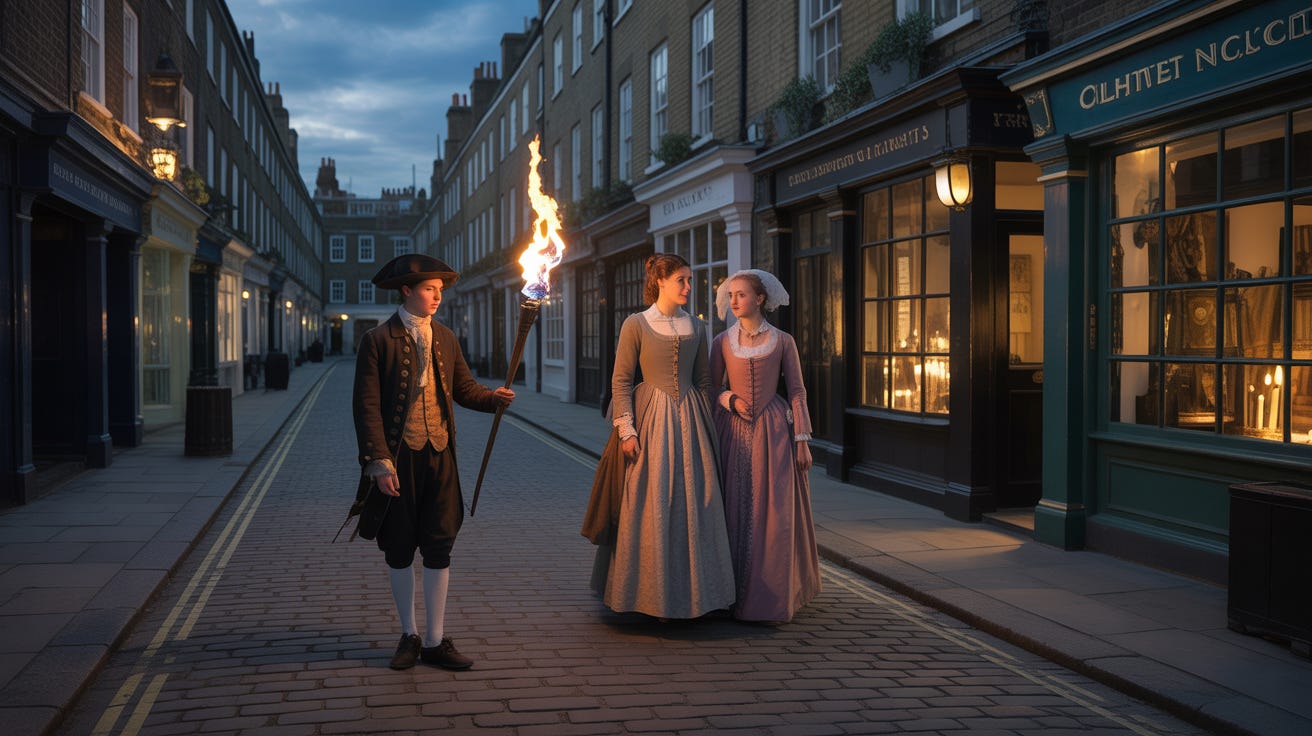
In 18th-century London, the city went dark after sunset.
Street lighting was inconsistent. Alleyways were uneven and often dangerous. Yet theaters filled, taverns overflowed, and luxury shops along the Strand and Covent Garden drew patrons late into the evening.
Between the glow of the storefront and the shadow of the street stood a figure with a torch.
The linkboy.
For a small fee — a penny, sometimes less — he would guide customers from carriage to shop and back again. He carried flame in one hand and navigated cobblestones with the other. Without him, the walk could feel uncertain. With him, the distance between shop and home shortened.
Commerce did not end at the door.
It extended into the dark.
The materials have changed. The link remains.
🧵 Where It Took Shape
Linkboys were not employees of the shops they served. They operated independently, often congregating near theaters and high-traffic commercial streets. Their work was informal, paid in tips, subject to weather and reputation. Some were children. Many were precarious.
But their role was essential.
Luxury retail districts depended on evening traffic. Evening traffic depended on safe passage. Safe passage depended on someone willing to carry light.
The linkboy did not own inventory. He did not negotiate prices. He did not stand behind a counter. Yet he enabled the transaction.
He absorbed the friction between the marketplace and the household.
Why it worked
Risk shifted outward. The physical danger of transit moved from merchant to intermediary.
Access expanded hours. Nighttime commerce became viable.
Compensation stayed flexible. Payment per task allowed elasticity without fixed payroll.
💡 What Shifted
The presence of linkboys reveals something structural about commerce: the store is never a closed system.
Between product and possession lies infrastructure — human, logistical, environmental. When that infrastructure is informal, it becomes easy to overlook.
The linkboy’s flame illuminated more than pavement. It illuminated dependency.
Retail has always relied on a class of facilitators who operate at the edge of visibility.
🔄 The Evolution
19th century — Industrial light replaces flame
Gas lamps and street lighting reduced reliance on torchbearers. Formal urban infrastructure absorbed some of the risk.
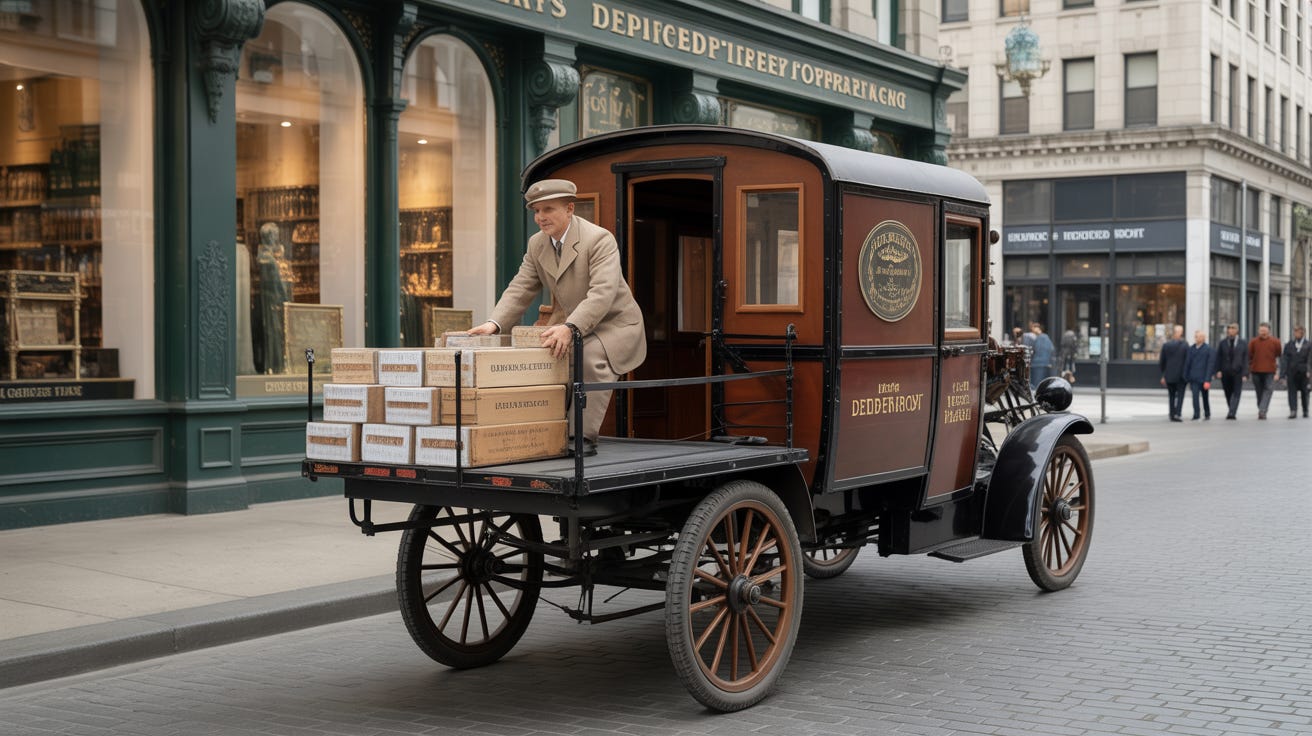
20th century — Delivery formalizes
Department stores developed in-house delivery fleets. Uniformed drivers and branded trucks extended reach. The link moved from independent youth to corporate payroll.
Late 20th century — Outsourcing scales
Courier services, parcel networks, and third-party logistics providers expanded rapidly. The link professionalized — and globalized.
Platform era — The gig courier
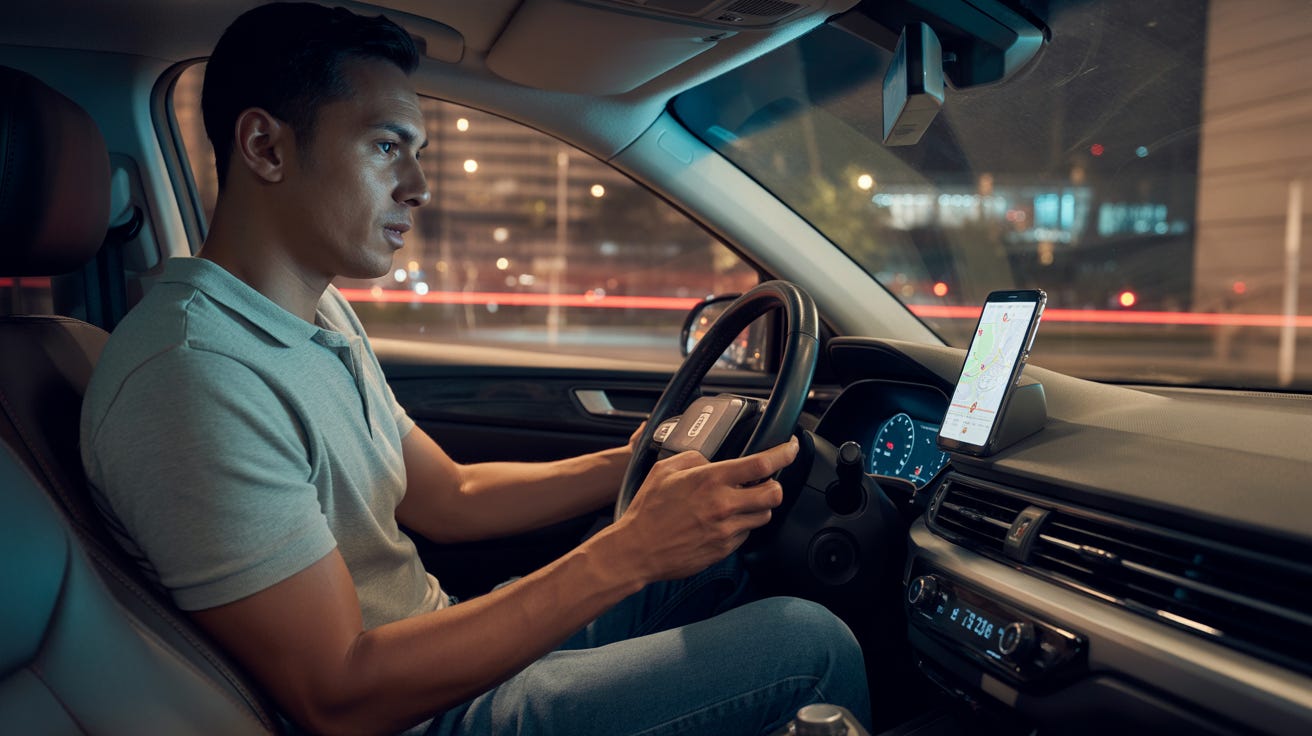
App-based delivery services match independent drivers to orders in real time. Ghost kitchens and dark stores operate without storefronts. The visible shop recedes; the intermediary becomes primary.
The torch is now a smartphone screen. The cobblestones are GPS coordinates.
The bridge remains human.
🌗 The Double Edge
Flexible intermediaries make commerce more adaptive. Gig platforms offer income supplementation, schedule autonomy, and entry without traditional gatekeeping. For many, this flexibility is not marginal — it is essential.
Yet flexibility often transfers risk. Weather, fuel, insurance, and time variability move onto the worker. The brand remains polished; the labor becomes dispersed.
The shadow workforce can be empowering.
It can also be fragile.
Commerce continues to rely on that tension.
🌟 The Echo Today
We see the shadow workforce in food delivery drivers, same-day parcel couriers, freelance pickers, and independent contractors bridging digital storefronts to physical doors. The restaurant may be a ghost kitchen. The store may be a warehouse. The customer may never see the infrastructure.
But someone carries the light.
In 18th-century London, it flickered at the end of a torch. Today, it glows from a phone mounted on a dashboard.
The link still closes the distance between shop and home.